 Skip to content

Writing things down can help you organise your thoughts, reduce the amount of information you are trying to keep in your head and turn vague ideas or goals into something you can actually act on. It also gives you something concrete to return to, making it easier to prioritise, track progress and remember what matters.
You do not need an elaborate journalling routine to benefit. A written goal, quick list, brain dump or few lines in a notebook can be enough to get something out of your head and make it easier to deal with.
What Are the Benefits of Writing Things Down?
Writing things down can help you:
- Reduce mental load
- Organise scattered thoughts
- Make goals more concrete
- Break big goals into manageable actions
- Make priorities easier to see
- Create a record of your progress
- Keep taking consistent action
Here is why something as simple as putting pen to paper can be so useful.
1. Writing Things Down Reduces Mental Load
Trying to remember everything takes effort.
Appointments, ideas, jobs you need to do, things you need to buy and that one important task you absolutely must not forget tomorrow can all end up competing for attention.
Writing some of that information down gives it somewhere else to live.
Psychologists use the term cognitive offloading to describe using an external action or tool to reduce the amount of information we need to hold internally. A 2026 meta-analysis of cognitive offloading research found that using external support can improve performance on memory-based tasks.
In everyday life, that can be as simple as writing down tomorrow’s appointments, the three things you need from the supermarket or an idea you do not want to lose.
You are not writing everything down because your memory is bad. You are giving your brain fewer things to keep juggling at once.
2. Writing Things Down Helps You Organise Your Thoughts
Thoughts rarely arrive in a tidy order.
You might be thinking about an unfinished job, something you need to reply to, an idea for work, a bill that needs paying and whether there is actually any milk left in the fridge, all within about thirty seconds.
Putting those thoughts onto paper separates them.
Once you can see them, you can start deciding what needs action, what can wait and what probably did not deserve quite so much headspace in the first place.
This is one reason a simple brain dump can be useful when everything feels busy. You do not need to solve each problem while you write. Get the thoughts out first and organise them afterwards.
You may even realise that some things belong on a Stop-Doing List rather than another increasingly ambitious to-do list.
3. Writing Down Your Goals Makes Them More Concrete
There is a big difference between thinking:
I really need to get fitter.
and writing:
I will walk for 30 minutes after work on Monday, Wednesday and Friday.
The first is a positive intention. The second gives you something much clearer to act on and measure.
Writing a goal down does not magically make it happen, but it can force you to define what you actually mean.
A large meta-analysis of goal progress monitoring covering 138 studies and 19,951 participants found that interventions encouraging people to monitor their progress improved goal attainment. Interestingly, the effects were stronger when progress was physically recorded.
The important part is not simply writing “be successful” on a page and hoping for the best. Your written goal needs enough clarity to guide your next actions.
If you have a goal in mind but are struggling to make it specific, our guide to how to write goals you’ll actually achieve takes you through that process in more detail.
4. Writing Helps You Break Big Goals Into Smaller Steps
Big goals often feel far more intimidating in your head than they do once you start breaking them apart.
Consider:
Declutter the whole house.
That sounds exhausting before you have even stood up.
Write it down and you can start asking a much more useful question:
What is the next thing I can actually do?
Maybe that becomes:
Fill one bag with clothes I no longer wear.
The overall goal has not changed, but the action now feels possible.
This is exactly why micro goals can make bigger goals easier to tackle. You can also use the Next Smallest Step method when you find yourself thinking about a task far more than you are actually doing it.
Writing creates space between the big outcome and the small action required today.
That is often where progress starts.
5. Writing Things Down Makes Priorities Easier to See
When everything stays in your head, everything can start to feel equally urgent.
It usually is not.
Writing tasks, ideas and commitments down lets you look at them as a whole and decide what genuinely needs attention.
You might discover that ten things competing for your attention actually contain three priorities, four jobs that can wait and another three that do not particularly need doing at all.
That is useful because productivity is not about squeezing an endless number of jobs into a day.
Sometimes the smartest move is deciding what not to spend your time on.
Again, this is where a Stop-Doing List can be just as valuable as another list of things you need to complete.
6. A Written Record Helps You Track Progress
We tend to notice how far we still have to go.
We are often much worse at remembering how far we have already come.
A written record gives you something more reliable than memory to compare against.
Maybe in January you managed one workout.
In February you exercised twice most weeks.
By March, you completed your first 5K.
Without a record, those gradual improvements are surprisingly easy to overlook.
Tracking also gives you information you can use. You can see what is working, where you keep getting stuck and whether the actions you are taking are actually moving you towards your goal.
That does not mean you need to record every detail of your life.
A few regular notes can be enough.
If you want to use writing more deliberately for reflection and personal development, our guide to journalling for self improvement is a good place to go next.
7. Writing Things Down Makes It Easier to Keep Taking Action
Writing something down once is not magic.
The real value comes when you return to it.
You write the goal.
You take an action.
You review what happened.
You adjust what needs changing.
Then you repeat.
That creates a very different relationship with a goal than simply thinking about something you would like to achieve one day.
This is also why consistency matters more than filling pages for the sake of it. A few useful lines written regularly can be more valuable than an impressive journalling routine you abandon after a week.
If you would like to make writing part of your normal routine, start with our guide to how to journal daily. The aim is not to write beautifully. It is to create something useful enough that you keep coming back to it.
What Should You Write Down?
There is no rule saying that a notebook has to contain profound thoughts.
Write down whatever is currently using mental space or deserves to be remembered.
That might mean your goals, ideas, tasks, appointments, decisions, next actions, things you have learned, progress you have made or something you suddenly remembered at 11:47pm and absolutely know will have disappeared by breakfast.
You can also use writing to capture why you made a decision. That can be surprisingly valuable months later when you remember what you decided but have completely forgotten why.
The best things to write down are usually the things that will help future-you think more clearly or act more easily.
Try the Two-Minute Write-It-Down Reset
If your head feels crowded, give yourself two minutes.
Write down everything currently demanding your attention without trying to organise or solve any of it as you go.
Once it is on the page, go back through what you have written and give each item one of four labels.
Do means there is a clear action you can take.
Decide means you need to make a choice before anything else can happen.
Later means it matters, but not right now.
Drop means you can stop giving it your attention altogether.
The point is not to create the world’s most organised list.
It is to turn a head full of competing thoughts into something you can actually see and deal with.
Notebook or Journal: Which Should You Use?
| Best for | Notebook | Structured Journal |
|---|---|---|
| Writing style | Free and flexible | Guided and structured |
| Ideal for | Ideas, lists, brain dumps and rough plans | Goals, actions, progress and reflection |
| Best choice if… | You want space to write whatever you need | You want a system to help you keep moving forward |
Both can be useful, but they solve slightly different problems.
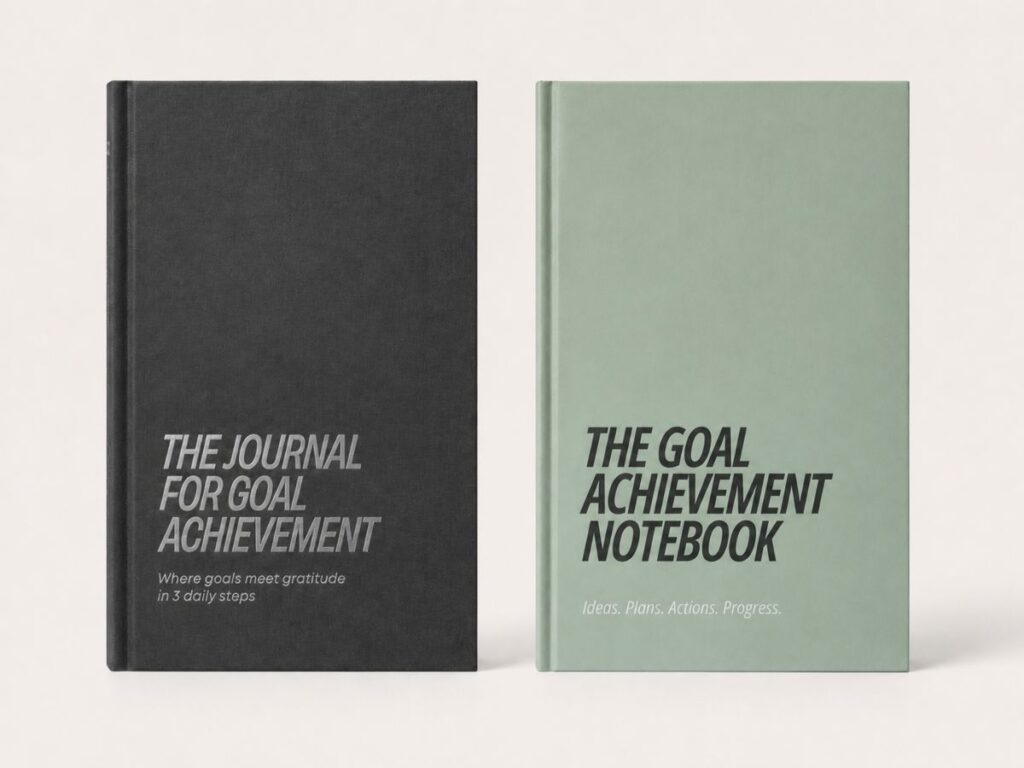
A notebook gives you freedom. It works well for brain dumps, ideas, lists, rough plans, meeting notes, thoughts and anything else that needs somewhere to live. Our Sage Notebook was created for exactly that kind of everyday writing: simple lined pages without prompts telling you what you should be thinking about.
A structured journal is more useful when you already know you want help turning goals into consistent action.
The Journal for Goal Achievement uses a structured system built around identity, goal setting, daily actions, progress and reflection. Rather than giving you blank pages and leaving you to work out what to do with them, it provides a framework to keep bringing your attention back to the goals that matter.
Neither approach is automatically better.
The useful one is the one that matches what you need from the page.
Sometimes you need structure.
Sometimes you just need somewhere to write everything down.
Does Writing Things Down Help You Remember?
Writing information down can act as an external memory aid, particularly when you have several things to keep track of at once. Research into cognitive offloading shows that external reminders and notes can improve performance on memory-based tasks.
There is an important distinction, though. Using a written reminder is not the same as permanently learning something. Research published in September 2026 found that people remembered information less well when they expected to have access to it externally later.
In other words, writing something down can help you manage information without necessarily making you memorise it.
If you need to remember to buy toothpaste tomorrow, that is probably fine.
If you are studying for an exam, you still need to learn the material.
Is It Better to Write Things Down or Type Them?
It depends on what you are trying to achieve.
Typing is quick, searchable and extremely useful when information needs to be edited, stored or shared. Writing by hand is slower and can encourage you to pause and process what you are putting onto the page.
Research has also found differences in the way the brain responds to handwriting and typing. In a 2024 study of university students, handwriting produced more elaborate patterns of brain connectivity than the typing task used in the experiment.
That does not mean handwriting is automatically better for every kind of learning, memory task or situation.
There is no need to turn it into a battle between paper and technology.
Use the format that helps you do the job properly.
We look at the differences in more detail in our guide to paper vs digital journalling.
Does Writing Down Your Goals Make You More Likely to Achieve Them?
Writing a goal down by itself does not guarantee that you will achieve it.
What matters is what happens next.
A written goal can make your intention clearer, while regularly recording and reviewing your progress gives you a way to see whether your actions are actually moving you in the right direction.
A large meta-analysis of goal progress monitoring covering 138 studies and 19,951 participants found that interventions designed to increase progress monitoring improved goal attainment. The effects were stronger when progress was physically recorded or reported.
So write the goal down.
But do not stop there.
Decide what you are going to do, keep track of what happens and change course when you need to.
Put It on Paper and Make It Useful
The biggest benefit of writing things down is not that paper has some mysterious power.
It is that writing can turn something vague into something visible.
A thought becomes an idea you can examine.
A worry becomes something you can deal with.
A goal becomes something you can define.
A big project becomes a next step.
And progress becomes something you can actually see.
You do not need to write pages every day.
Start with the thing currently taking up the most space in your head.
Write it down.
Then decide what happens next.
Discover more from Goal Achievement Hub
Subscribe to get the latest posts sent to your email.

