 Skip to content
When you’re stuck in your head, you don’t need more theory, you don’t need to read more, research more, you need motion. If you want to stop overthinking, the fastest path is to write everything down, choose one item and shrink the task until action becomes unavoidable. That’s the Next Smallest Step Method: one clear move you can do now, not later.
This post shows you exactly how to stop overthinking with a paper-first routine you can repeat every day, then pairs it with a light digital workflow so momentum is easy to keep.
Why we overthink (and how to break it)

Overthinking thrives on three things: uncertainty, too many options, and constant notifications. We can spend far too much time researching content online or reading too many book in search for the perfect plan. This is known as mental masturbation.
A page in a notebook and a pen cut through all three. Paper slows the mind just enough to see the work, choose the priority, and make your move. That’s how you stop overthinking and start making progress.
The Next Smallest Step Method (H2)
I have found that the best method to kill mental masturbation is to identify a meaningful task that is in alignment with your goals and break it down to the point where it is small enough for you to begin making a start.
Here’s the simple flow:
- Brain dump (2 minutes).
Write everything on your mind on paper. One line per thought. - Choose one priority.
Circle the item that would make today a win if completed. - Shrink it.
Turn that item into the Next Smallest Step you can complete in ~10 minutes (e.g., “email Sarah draft outline”, not “finish proposal”). - Do it now.
Start the step immediately. If it still feels heavy, shrink it again. - Repeat.
After the first win, pick the next smallest step. Momentum compounds.
Use this to stop overthinking in minutes, not hours.
Taking the first step, no matter how small is often all it takes to take further action. Small steps forward lead to bigger steps. The best example of this is often when ever we feel that we must do something like tidying the house or going to the gym, the hardest part is often picking up the hoover or getting your shoes on and going to the gym. Once you get to the gym and warm up for five minutes, you don’t quit, everything becomes easy and you can then train for a full hour.
Note: If you're interested in learning more about this method, you can watch my livestream on YouTube on this topic.
How to set it up in the Journal
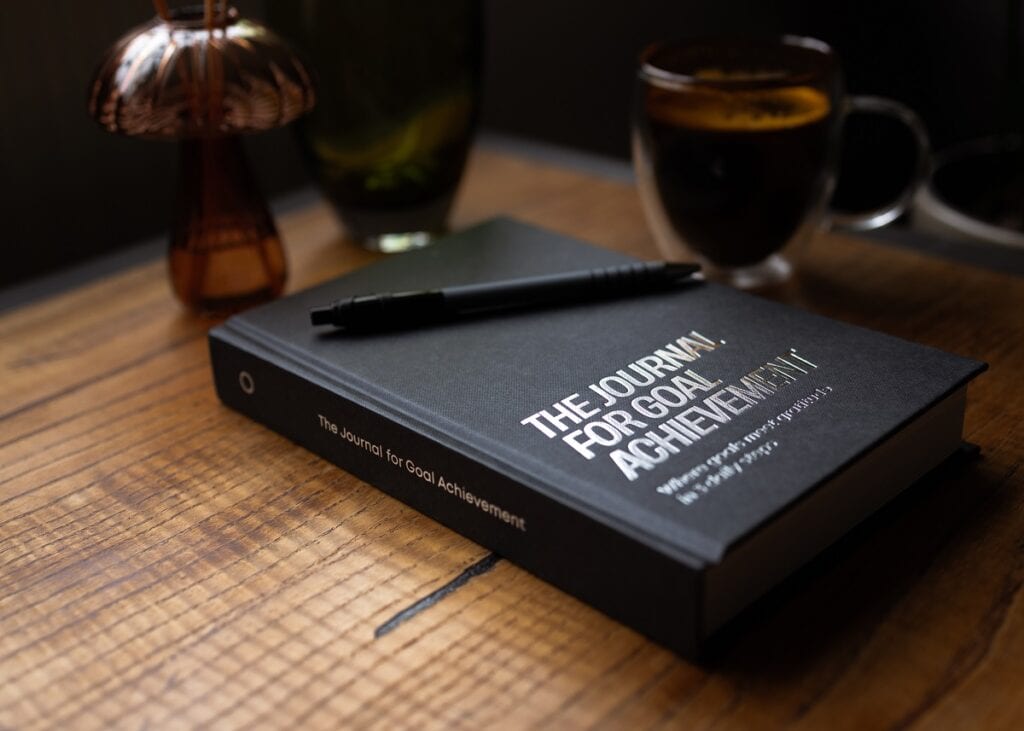
The Journal for Goal Achievement makes the method effortless:
- Identity cue: One line on who you’re choosing to be today (keeps decisions aligned).
- Top 3 daily actions: Write each as a Next Smallest Step.
- Gratitude & reflection: Log wins, note the bottleneck, refine tomorrow’s steps.
Paper for deciding; digital for storing and sharing outcomes. Think on paper, catalogue on screen.
Prompts that switch you from thinking to doing
Let’s get back to making your first small step.
- If I only had 10 minutes, what would I start?
- What’s the first keystroke or first call?
- What can I finish before I open email?
- What proof of progress can I create today?
Answering any one of these will help you stop overthinking on the spot.
A 7-day challenge to build momentum
For the next week:
- Morning: Brain dump → Circle one → Write the Next Smallest Step.
- Do a 60–90 minute focus block on that step before checking messages.
- Evening: Note one win, one improvement, and tomorrow’s first step.
By day seven, you’ll have tangible results and a calmer head, because you trained yourself to stop overthinking and act.
The next step is to increase this one small step to two small steps, then three. If you can build up to achieving 3 small steps each day, you will have reached the secret balance to setting and achieving any goal (based on S.M.A.R.T. principles).
Why choose only 3 daily actions?
Why not set 10 tasks for the day? After all 3 tasks sounds too easy right?
Yes that is correct, and that is why 3 small tasks is the right number, because it is sustainable and a small amount of effort continuously applied is the secret to success.
Have you ever written down a “to do” list of 20 items for the day and tried to complete them all only to have most of the items on your list still outstanding at the end of the day? These items then need carrying over to the next day and the next day and the next day…
Maybe you can do 20 things in a day once, but it is not sustainable. Committing to 3 things day is sustainable EVERY DAY and this is where we must focus to get the compounding effect that leads to results over time.
I am not suggesting that you should stop there. Commit to 3 as a minimum and if you do more, this is a bonus.
Tip: Each day, ask yourself "what are the top 3 things I can do today that will make a difference?" and do them!
Something my coach Scott said that has always stuck with me is “we overestimate what we can do in a day but underestimate what we can do in a year“. A wider version of this was best said by Tony Robbins “”Most people overestimate what they can accomplish in a year and underestimate what they can achieve in a decade“. Both are true. We really think that we can do everything in a day or a month. We are impatient by nature and want instant results. Delayed gratification is a super power.
Common blockers (with quick fixes)
- “I need the perfect plan.”
Fix: Ship a 10% version today; iterate tomorrow. This is the essence of Minimum Viable Product (MVP). - “Too many priorities.”
Fix: Cap at Top 3. Everything else goes to a parking lot. - “I keep getting distracted.”
Fix: Phone in another room, one tab full-screen, visible journal open. Commit to working in focused blocks of time and leave all messages and emails until later. - “Tasks feel vague.”
Fix: Rewrite each as a physical action with a clear start (dial, draft, outline, schedule). Use S.M.A.R.T. principles to ensure that the action is SPECIFIC and MEASURABLE.
Why this pairs perfectly with paper
Typing is fast, but fast isn’t the goal. The goal is progress. Handwriting forces you to rephrase in your own words, which boosts clarity, memory, and follow-through. That’s why a paper-first approach helps you stop overthinking and keep moving.
Read our recent article on why writing your ideas down on paper has advantages.
Ready to move, not mull?
If you want a structure that makes action automatic, use The Journal for Goal Achievement. It guides you to set identity, choose your Top 3 as Next Smallest Steps, and review in minutes.
- Order The Journal for Goal Achievement from the Goal Achievement Hub shop – fast worldwide delivery
- Buy on Amazon UK – with Prime convenience
-


The Journal for Goal Achievement – Goal Setting & Gratitude Journal (Graphite)
£22.49 Add to basket -

The Journal for Goal Achievement – Goal Setting & Gratitude Journal (Sand)
£22.49 Add to basket -
Sale!

5-Pack Journal for Goal Achievement – 3 Graphite & 2 Sand | Goal-Setting Planner
Original price was: £112.45.£95.58Current price is: £95.58. Add to basket
One page. Three steps. Daily momentum. That’s how you stop overthinking and start winning the day.
Discover more from Goal Achievement Hub
Subscribe to get the latest posts sent to your email.

